

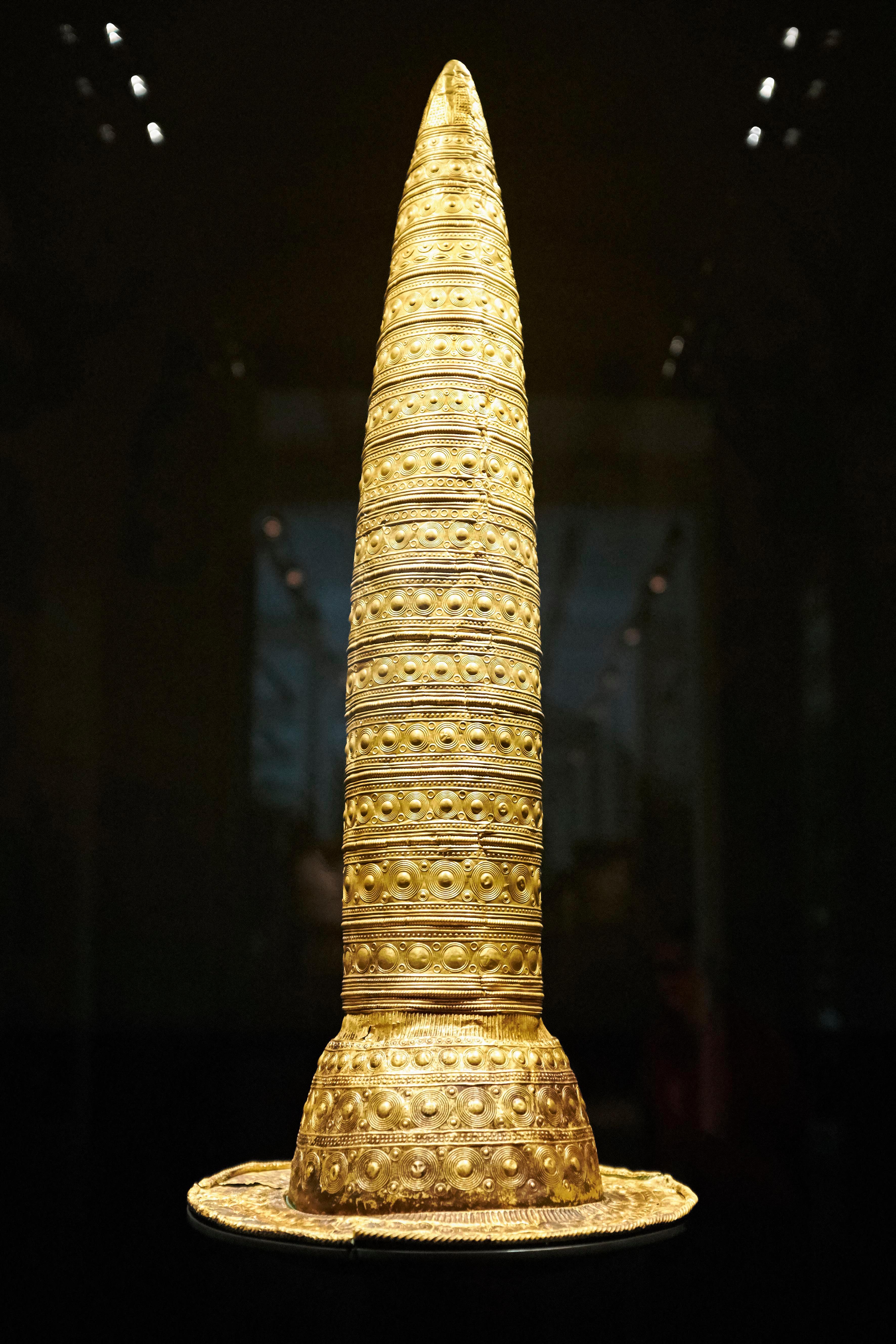
Name: Berlin gold hat
What it is: A tall, conical hat
Where it is from: Likely southern Germany
When it was made: Circa 1000 to 800 B.C.
This tall, conical hat made from a single sheet of hammered gold was likely worn by an ancient priest during a sun cult ceremony. The Berlin gold hat is the best preserved example of only four Bronze Age accessories of this type that have been found in Central and Western Europe.
The gold hat is in the collection of the Museum of Prehistory and Early History in Berlin. The museum acquired the artifact in 1996 after it circulated on the antiquities market. As a result, it is unclear where the hat was found, but the other three known Bronze Age gold hats were discovered in southern Germany and western France.
The hat is roughly 29 inches (74 centimeters) tall and weighs just over 1 pound (480 grams). It is accented with a flat bronze band with a bronze wire bordering its brim. A wool or felt lining was likely worn underneath the gold hat to stabilize it, but no traces of a lining remain.
Bands of decoration on the Berlin gold hat make the artifact stand out. The repeated motifs of concentric circles, disks, ovals and other symbols encode numerical values that correspond to a calendar, archaeologist Wilfried Menghin argued in a 2008 study. Each band represents a numerical value, and combinations of bands can help calculate lunar months and solar years, as well as convert between lunar and solar dates. The calendar can also be used to predict lunar eclipses.
"The person who wore this hat was the carrier of secret and very special knowledge," Matthias Wemhoff, director of the Museum of Prehistory and Early History, said in a translated 2018 video. Wemhoff described the hat's wearer as a priest who may have come out on a mountaintop at sunrise. The glistening gold hat would have caught the sun's first morning rays, dazzling the other participants in the ceremony.
Although there are no historical records of a Bronze Age sun cult in Europe, other astonishing artifacts, such as the Trundholm Sun Chariot and the Nebra Sky Disk, showcase the importance of celestial bodies to these prehistoric societies.
For more stunning archaeological discoveries, check out our Astonishing Artifacts archives.
Can you put together last week's Astonishing Artifact?





 Bengali (Bangladesh) ·
  English (United States) ·