

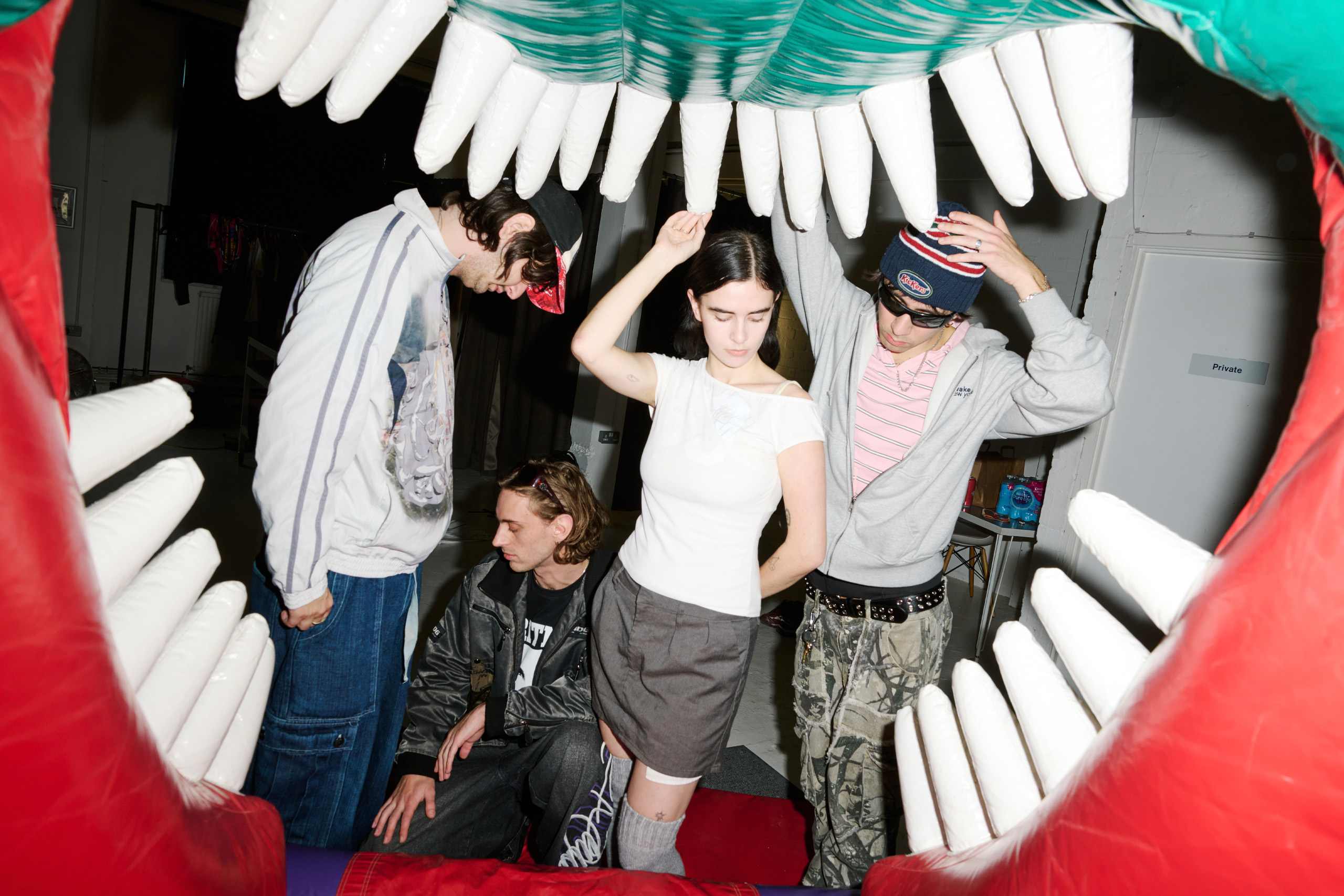
For their NME Cover, RIP Magic – one of London’s buzziest bands this year – insisted on renting, of all things, a bouncy castle. “We’re pretty obsessed with inflatables,” shrugs Marco Pini. A key inspiration for the band’s debut album ‘1,2,3’, he explains, was the Macy’s Thanksgiving Day Parade, a garish American tradition where enormous balloon iterations of pop culture characters are dragged through Manhattan. An image of one giant figure which appears to be Pikachu, but is so badly photographed that it’s hard to tell for sure, is included in a Dropbox folder of images the band’s representatives send over before our interview, instead of the customary written biography.
It also included a hot air balloon with a grotesque approximation of Rocky Balboa painted on its side, X-rays of a foot in various shoes, Pope Leo XIV holding a baseball bat on a plane (an image that is not, though it looks like it, AI-generated), and a woman with the cartoon cat Garfield crudely daubed on her face. As daft as many of the pictures are, says drummer Beth Boswell-Knight, “we didn’t want any laughing or smiling shots. We wanted very serious people in a very serious scene.” Whatever it is these weird images have in common – a silly seriousness, a chronically online sense of humour, a love of weird juxtapositions – it resonates with RIP Magic’s unique blend of lithe beats, squirming melodies, detached vocals and teeming samples.
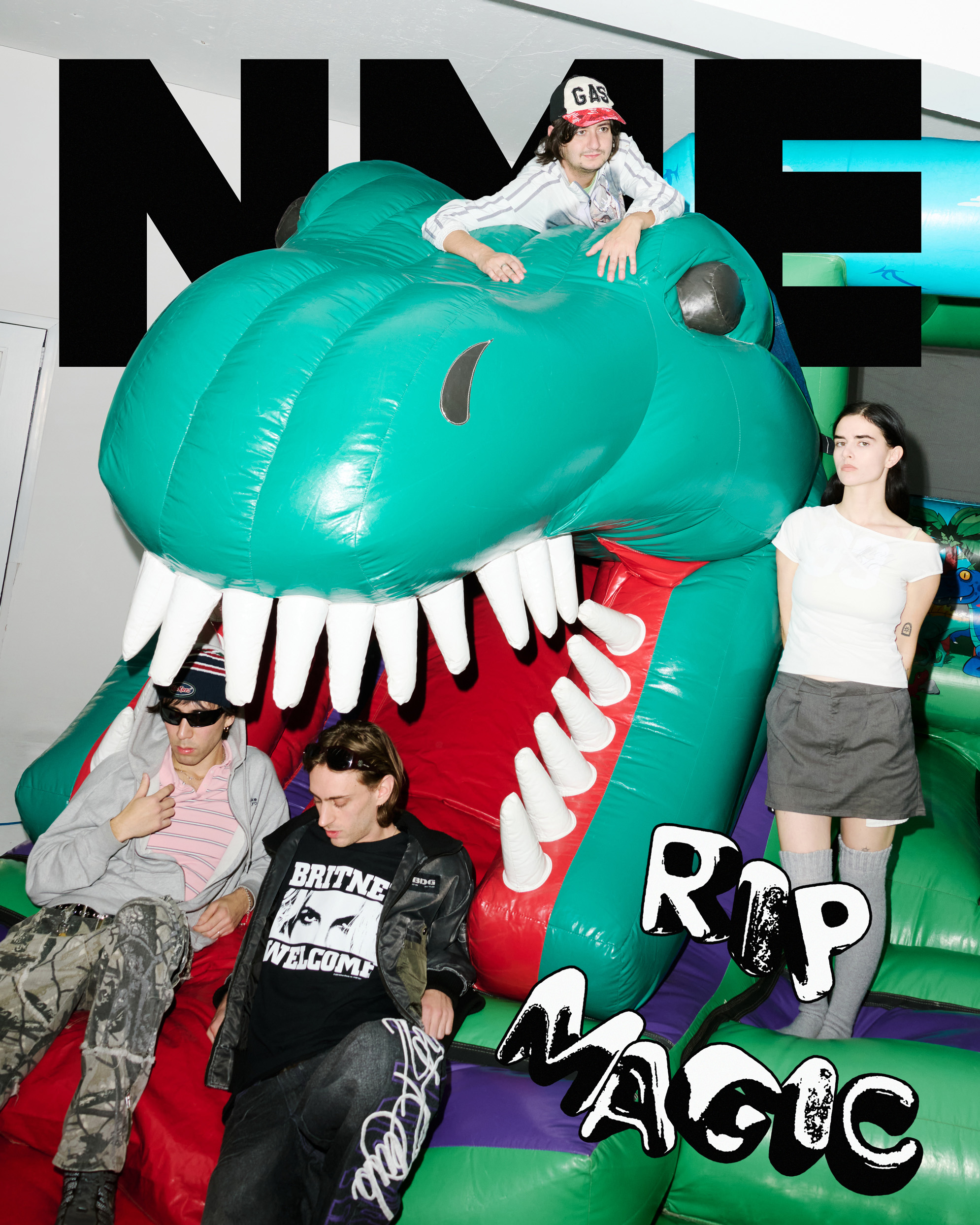 RIP Magic on The Cover of NME. Credit: Bob Foster for NME
RIP Magic often refer to the band as an external entity. “We talk about RIP as a mood or a theme, rather than something personal,” says Pini. “We can all point to something that feels like it’s very RIP. There’s a shared code that I think we understand, and if you follow your gut, I think it’s quite easy to see the parallels.”
Fundamentally, RIP Magic are all about following the gut, preferring to show rather than tell with a hectic, head-spinning take on dance and indie music. “If there was some kind of formula, it wouldn’t work,” says Boswell-Knight. “We just sort of go in, make sounds, songs come out. There’s a tongue-in-cheek humour in them,” adds Pini. “The music’s brash and naïve, with a kind of surreal spectacle to it.” His lyrics are written as a stream of consciousness, their meaning revealed after the fact. “I often find it interesting to read them back, and realise ‘oh, that’s what I was trying to say’.”
 Marco Pini of RIP Magic. Credit: Bob Foster for NME
It’s not as if the quartet wouldn’t have plenty to brag about in a conventional biography. Pini, also a member of much-acclaimed indie outfit Sorry and the founder of taste-making record label Slow Dance, has known Felix Bayley-Higgins since sixth form. They’ve worked together in various forms for a decade, often trying to cram as many ideas as possible into their work, to varying degrees of success. Eventually, “we came to the realisation that we wanted to do stuff that was a bit more vital, that relied less on bells and whistles,” says Bayley-Higgins.
On bass, they enlisted Pedro Takahashi, who’s primarily a filmmaker by trade – and has directed music videos for Shame, Humour, Sam Akpro and Real Lies – but also a member of hardcore-leaning band Ex-Family, whom Pini booked for a Slow Dance show at The Windmill after a chance meeting in Los Angeles. He was reluctant to make the leap to a project so ambitious. “Felix and Marco had so much intention from the start,” he says, “but it got to a point where I thought, if I don’t do this now and give it a crack, I never will.” A few months down the line, they realised that their meeting was in fact pre-ordained: Takahashi discovered that an old photo he’d found online years ago of two men at sunset on Hackney Marshes, and saved to a folder he used for moodboarding, was in fact his future bandmates Pini and Bayley-Higgins. “I’d only screenshotted it because I liked the vibe, but I felt some sort of kinship to it. Then years later when I met Marco and Felix I realised, ‘wow, you guys are on my computer!’”
 Felix Bayley-Higgins of RIP Magic. Credit: Bob Foster for NME
Drummer Boswell-Knight was also from a visual background – which explains their tendency to describe the “RIP vibe” through images rather than words. Pini knew her as a photographer who would often shoot Slow Dance events. “Somehow he found out I played drums, and the next week we did a rehearsal.” It was her first time drumming in five years; her only prior experience had been in an older indie band she met via Facebook Marketplace in Glasgow. “I responded as a joke, but then I ended up really liking their music. We never played live, though; my first time getting onstage was with RIP. I remember there being this energy right from the start from Felix and Marco, ‘we’re gonna do a week of rehearsals then book all of these shows,’ whereas I was like, ‘I’ve never played a show, I haven’t played drums in five years, what is going on?’”
For Pini, that was an advantage. “Session people didn’t feel right for this project. It was quite intentional that we should all be starting on the same page and grow together,” he says. “None of us are technically trained,” adds Boswell-Knight, “so it’s more like a pure expression in the way that we want to express it.”
“We’ve always been quite clear about what we want and how we’re going to get there” – Pedro Takahashi
It all comes back to that first-thought-best-thought, follow-your-gut instinct. That balance of ambition and naivete, combined with a leaner, meaner, stripped-back approach to songwriting, brought RIP Magic immediate acclaim. Frenetic live shows had them hyped nationally before they’d released a note on record. Tyler, The Creator was an early fan, and asked for their demos after hearing Pini and Bayley-Higgins play a DJ set. So was LCD Soundsystem’s James Murphy, who offered to make a rare trip to the producer’s chair for early single ‘5words’. This in turn led to Laurie Anderson lauding what she called their “spinal music”. Kevin Parker was converted too, and invited them to support Tame Impala on a European arena tour. “It’s all been a bit ridiculous,” says Pini. “Like, James Murphy? Tame Impala? What the fuck?”
 Pedro Takahashi of RIP Magic. Credit: Bob Foster for NME
The four are reacting to the hype differently. Boswell-Knight admits, laughing, to “massive imposter syndrome,” while Bayley-Higgins is “on some ‘live the movie’ type shit”. For Takahashi, “there is a certain amount of pressure, but I feel like the project has been so intentional from the start. I don’t think it was like ‘oh, shit, now we suddenly have to do good,’” he says. The easiest way to stay grounded, he continues, is to stick to that purely instinctive way of working that brought success in the first place. “We’ve always been quite clear about what we want and how we’re going to get there.”
They’re mostly just grateful for the opportunity that growing status affords them to keep expanding that ‘RIP world’. Take the launch for ‘1,2,3’, for instance, where they invited the car club Southeast Tunerz to park outside Milwall’s football stadium and blast the record at maximum volume from their vehicles’ tricked-out speakers. Pini and Bayley-Higgins had been harbouring the idea for years after growing obsessed with social media clips of wild car audio subcultures from around the world. “There’s just something about the aesthetics of these massive speakers” that fits well into that hard-to-define ‘RIP vibe’, says Pini. It’s only now, though, that they’ve accumulated the clout to turn their idea into reality. “We quite like using [success] as a vehicle to do things like that, just for the sake of doing them,” says Bayley-Higgins.
 Beth Boswell-Knight of RIP Magic. Credit: Bob Foster for NME
Like how the significance of Pini’s subconscious lyrics only discloses itself after he’s written them, what often appears impulsive with RIP Magic will later reveal greater depths. “I think the Barbican also did some kind of exhibition [about that subculture], but they’d put it in a high culture vacuum,” says Bayley-Higgins. “It was stale.” Adds Pini: “We wanted to hook up with an actual community who are turning up in a random spot and blasting noise, putting their heads in the cars and watching their hair go crazy. It’s kind of illegal; it’s also fun. One thing I’ve realised about the RIP vibe is that it needs to be positive, bring people together.”
RIP Magic’s directness, which is in contrast to the intellectualism common among many of their contemporaries, has led some to mistake them for enigmas. Some try to hunt for deeper meaning in all those disparate images, when really, they’re to be taken entirely at face value. “We were slightly surprised when we got billed as ultra mysterious,” says Bayley-Higgins. “We came to this with the intention of being vulnerable and saying ‘fuck it’, worrying less and going with the first thought.” Viewing the band as a puzzle to be solved is to overthink it. “I get so annoyed with irony in music,” says Pini. “It rubs me the wrong way.”
“One thing I’ve realised about the RIP vibe is that it needs to be positive, bring people together” – Marco Pini
“There’s safety in irony, because you never get to the point of things; you don’t expose yourself,” says Takahashi. “I think that some of Marco’s lyrics are quite emotional and direct.” (“You know you had to live it for yourself in spite of me / You said the drama is a body that’s inside of me”, he spits on the album’s moodiest cut, ‘Rock’.) RIP Magic are aware that they emerge at a saturated time for south London indie bands, but say they’ve always felt like outsiders to the so-called ‘Windmill scene’. “This project is quite consciously not that,” Takahashi says.
It might be difficult to say exactly what an inflatable dinosaur, tricked-out car speakers playing so loudly it makes your hair fly up on end, and a screenshot of two people at sunset imbued with near-cosmic significance all have in common, but it’s definitely something, and whatever that something is to you, that’s what RIP Magic can provide. There are no right or wrong answers; sometimes, it’s best just to go with whatever pops into your mind first.
RIP Magic’s ‘1,2,3’ is out now via section1.
Listen to RIP Magic’s exclusive playlist to accompany The Cover below on Spotify or on Apple Music here.
Words: Patrick Clarke
Photography: Bob Foster
Bouncy Castle: YMA Bouncy Castles
Location: 69 Drops Studios
Label: section1
The post Behind the curtain with RIP Magic: “If there was some kind of formula, it wouldn’t work” appeared first on NME.




 Bengali (Bangladesh) ·
 English (United States) ·