

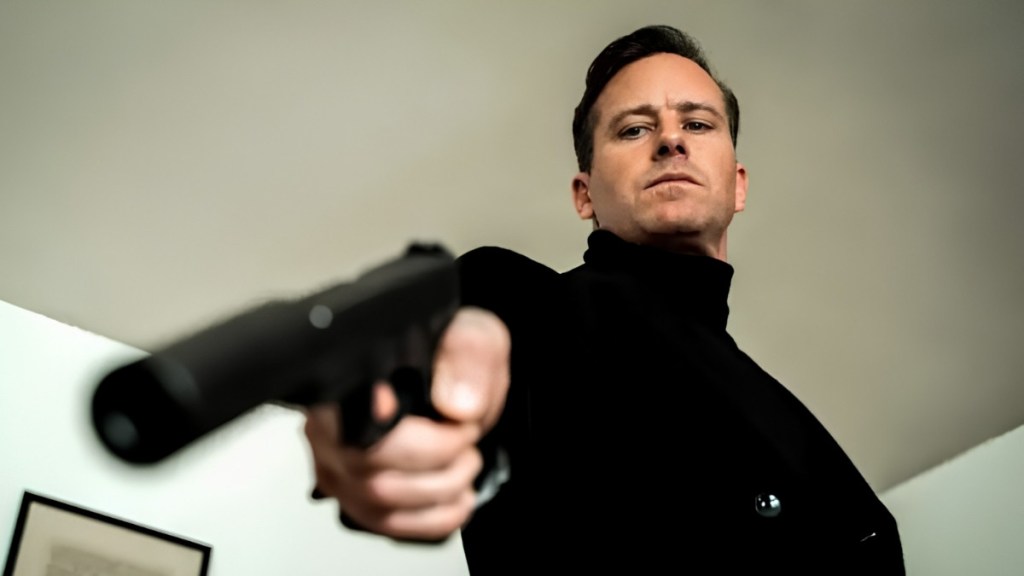
 (Photo Credit: Quiver Distribution)
Armie Hammer’s first lead role since Death on the Nile comes out this week. Directed by controversial German filmmaker Uwe Boll, Citizen Vigilante sees Hammer playing an American living overseas who becomes a vigilante and gains civilian support for his violent retribution. ComingSoon spoke with Hammer about the film (which faced release issues in Germany), his career comeback, and why he wouldn’t change a thing about how his scandal unfolded. The action thriller movie is out June 19, 2026, from Quiver Distribution.
“Citizen Vigilante story is Sanders (Hammer), a wealthy American businessman living in Zagreb who inherited a massive real estate empire from his late father. Intelligent, isolated and emotionally scarred, Sanders transforms himself into a feared underground vigilante targeting violent criminals, rapists and corrupt judges who escaped meaningful punishment through the legal system,” says the synopsis.
Tyler Treese: Armie, congrats on the film. This is your first lead role in a while. How was it being first on the call sheet again and just getting back into the rhythm of shooting a full film?
Armie Hammer: Man, it felt so good. I’ll be honest. It really just made me so happy because I’ve done some things since, and I think I did one before, but it was a smaller supporting role.
I’m just happy for all work, dude. I had a dry spell there, a little dark night of the soul, if you will. It was incredibly painful, but incredibly helpful. Now, to be back to work, I just appreciate all of it so much more.
I want to dive into that response a little bit because you don’t seem to have a lot of animosity toward the scandal and the fallout. I saw in another interview that you said, “Healthy people don’t act the way I was acting.” It seems like you’re really able to reset and focus on your kids and what really matters in life. How was it finding positives in a situation that really could have just led to a negative spiral and doubled down on your worst tendencies?
It’s interesting. Everything is, or nothing is ever one thing, right?
Even the best experience you’ve had in life will have some little tinge of, “Yeah, but the fallout,” or this or that. The bad things that happen to us, we put the label of bad on them because it’s easy and quick. But there were such beautiful things that came out of it. The things that you said, I wouldn’t trade for the world. I really wouldn’t.
I’ve said this for years privately to people I talked to about it. If I found a genie lamp, and there was a genie in there, and I rubbed the lamp and the genie came out and said, “You get one wish, and that’s it. Just one. Your one wish can only be that you go six years back in the past and redo all that stuff,” I wouldn’t take the wish.
There’s a part of me that goes, I learned lessons that I needed to learn, and I learned important things that I hope to carry with me for the rest of my life. Was it the heaviest and most painful thing I’ve ever been through in my entire life? Yeah. But because nothing is ever one thing, was it also the most beautiful in a way? Yeah.
In this film, you’re playing a complex, complicated protagonist. Taxi Driver always comes to mind as one of those touchstones. That used to be something, and maybe it still can be, that we would praise actors for taking on. However, I’ve seen there are already some detractors about this film and even doing a role like this.
Why do you think people want to shy away from even depicting a complicated figure? I certainly didn’t watch this film and feel like it was a co-sign for every single thing your character did. Even if you agree with him on some points or not, he’s clearly a sociopath, and I don’t think that’s up for debate.
Yeah. It’s interesting. My approach to this character, Sanders, the more I read it, the more I got a vibe that this dude feels almost on the spectrum to me, where he has such a clearly defined sense of what the world should be, and it is very black and white. There is no gray in this guy’s life.
So I wanted to understand how he could exist in this world. As an actor, it’s more fun playing a character who’s not close to who you are. I live in a world of gray. This guy does not. To be in that for a little bit and have the opportunity to have such a clearly defined sense of right and wrong, even if it’s entirely subjective and not a global thing.
It’s fun working on a movie that has a very specific point of view. I don’t have to agree with the view to do it. I always say I wasn’t a twin when I made The Social Network. I’m not gay in Call Me by Your Name. You get to do all these things that are outside of your wheelhouse, and that’s the fun of it for me. That’s the juice from the squeeze.
How do you approach playing a role that is so unlike yourself? Is it internalizing and trying to look inward for the character? Do you do a lot of research? What was your prep like for Citizen Vigilante?
Armie Hammer: I do a lot of research. I subscribe more to the Stella Adler approach, where first and foremost you need to learn who you are and have a very clear sense of what you think about things and how you feel about things. Then you can get into the psychology of the character and figure out how they think about things and how they feel about things.
That way, you can have a clear delineation between yourself and the character so that you don’t accidentally let yourself bleed through too much. Obviously, it’s like a Venn diagram. There’s going to be overlap always. But really getting into the psychology behind it helps me find what I’m trying to do.
I like that you’re honing in on the psychology because your character has almost a philosopher quality to him. Even if he’s going about things the wrong way, he is thinking about issues and definitely feels the systems are broken. He is quoting Nietzsche. What did you find most interesting about his own unique path that he is espousing? There are scenes where you’re doing these manifestos that he’s putting online. What interested you most about that element of the film?
Armie Hammer: Going back to the Venn diagram thing I was talking about, where there’s always going to be some overlap, maybe it’s big, maybe it’s small. Even though Sanders is a very complicated character in the sense that his convictions are not necessarily shared by huge amounts of people, there are people who feel exactly like he does.
There are also aspects of all of us that have a sense of what we feel is right or wrong. I don’t think you’d find a single person in the world who feels like they have never been wronged or that an injustice has never been committed against them.
A lot of times, the people who feel like they’ve been wronged feel like they got no justice for it. I know I’ve felt like that. I think everybody has felt like that. So to get to do something about it in a sanctioned, safe way through art is kind of a release in a fun way.
Tyler Treese: There were release issues with the film in Germany. Uwe Boll has been vocal about that. It raises an argument about freedom of speech. What was your reaction to the classification issues in Germany?
Armie Hammer: I could be wrong about this, but I don’t know that there are many other countries in the world that have the right of freedom of speech built into their constitution or charter. That’s kind of a very specifically American thing.
If Germany wants to ban the film, they can do whatever they want. I think that might backfire on them. Human nature is a really funny thing. I talked about this earlier, but let’s say you walk to work every day. You might walk past a fence that has a knot hole in it a thousand times and never think about it. But one day, if you walk by that fence and there’s a big sign over the hole that says, “Do not look through this hole,” how many times will you be able to walk past that fence before you’re like, “I’m looking in the hole”?
That’s human nature. That’s Adam and Eve. It’s the forbidden. We always want that which we can’t have. So I don’t know. Maybe all the people in Germany will go, “Wait, this is banned in Germany? Now I have to see what this is.” Maybe they’ll go on Amazon in Austria, get a VPN, or maybe they’ll just pirate the film. Who knows?
But I don’t think it’s going to keep people from watching it. I don’t think that’s how nature works.
Tyler Treese: I saw another interview where you said it was just so fun to shoot. I was curious, had you ever gotten a bit disenfranchised with film? I know it’s clearly one of your passions, but did you feel like this had reignited your passion in any way?
Armie Hammer: No, I never got disenfranchised. I feel so lucky and fortunate that I got to do, and now get to do again, the thing that feels like what I’m supposed to do. I don’t want to sound over the top, but it’s what I love. It’s the thing that makes my soul happy.
Maybe there were times where I wasn’t as grateful. I’d be sitting around waiting on set and thinking, “Why aren’t we shooting? This is so slow,” and getting angry about things that now I would never get angry about. I would just be so happy and grateful. Maybe that’s also one of the important things I had to learn.
Tyler Treese: I always found it interesting how you navigated the Hollywood space because you would do these blockbusters, but you would also do very intellectually challenging films like The Birth of a Nation and Sorry to Bother You. But you also did stuff like Mirror Mirror and more blockbuster fare. Was that mixture always interesting to you? Did you feel like both of those avenues were different creative outlets for you?
Armie Hammer: I do. I had a meeting very early on in my career when I had just really started working. I don’t think I had even done The Social Network yet. I met with a director who is a huge director, maybe one of the biggest. He told me in the meeting, “I have a feeling that you’re going to work, and that you’re going to work a lot. Let me tell you advice that was given to me: do one for them, one for you. One for them, one for you.”
The one for them is maybe the big studio project or the project where you get a good paycheck. Then the one for you is the one that you do so that you feel good about yourself. That being said, I felt like every one of them was one for me. I just love this. I love it.
Tyler Treese: You were so great in The Social Network, and that’s getting a spiritual successor now, The Social Reckoning, with Aaron Sorkin writing and directing. It seems stand-alone, so I don’t really feel like it will have any impact on that masterpiece’s legacy. But did you have any thoughts about this modern masterpiece getting a sequel? I know Sorkin was very open about wanting Jesse Eisenberg back. Did you have any thoughts about that being touched again?
Armie Hammer: I’m still in communication with some of the people who were involved in the original film, and I knew early on that there was no space for the Winklevoss twins in this movie, which is totally fine. I feel like what we made was a really special thing. It really touched on a zeitgeisty thing in a way that is hard to do for films because from the moment an idea comes up for a film until the moment it comes out, it takes a lot of time. But I think both Sorkin and Fincher nailed it, and I’m really proud of that movie.
Maybe more people will watch The Social Network again. If they do, great. If they don’t, great. I’m sure The Social Reckoning is going to be amazing. I can tell you one thing: the writing is going to be incredible.
Tyler Treese: Night Driver you have coming up. What can we expect from that? I read it’s a Mafia movie.
It’s so fun, man. It was a great experience. I got to shoot it in LA. I hadn’t shot a movie in LA since J. Edgar, which was probably 2012 or 2013. To get to work in LA was great.
The story takes place all over one night, so it was all night shoots for the film, which was brutal. But it was such a fun little project, and it was extremely shoestring. I got paid almost nothing for it, but really had the time of my life.
America loves redemption stories. Are you hoping to get back into the studio system? Johnny Depp is getting back into it now. It seems like the door will eventually open up.
One thing I learned is I don’t have the luxury of thinking down the line anymore. Because if I say, “Down the line I want this,” it’s never going to come as quickly as I want it to, and the journey there isn’t going to look how I think it should.
For me now, it’s about finding joy and pleasure in the things that I’m doing today. That’s pretty much it. Would getting back into the studio system be great? Absolutely. Would I love that? Absolutely. Do I need that? Not really. I’m happy with what I’ve been doing, and if my life now looks like making two to three, maybe four cool indie projects a year, I’m totally good with that.
Thanks to Armie Hammer for taking the time to talk about Citizen Vigilante.
The post Armie Hammer’s Career Collapse Was The ‘Most Painful’ and ‘Most Beautiful’ Experience of His Life | Interview appeared first on ComingSoon.net - Movie Trailers, TV & Streaming News, and More.





 Bengali (Bangladesh) ·
  English (United States) ·