

If you have a dog, you likely know how good these animals are at reading subtle cues. Jangle a key or dangle a leash and many pooches know it’s time to go outside. But man’s best friend may be even more in touch with our feelings than we realize. Dogs can distinguish between certain emotions just by looking at our faces, a new study suggests.
The results offer a new peek at what’s going on in canine brains. That could offer clues to how dogs’ emotion-sensing skills evolved, says Laura Cuaya. She’s a neuroscientist at the University of Vienna in Austria. The findings also give another reason to smile at any pup that crosses your path, she adds. They just might understand.
Past studies had shown dogs can tell if someone’s face is wearing a positive or negative expression. The two emotions seem to trigger activity in different areas of a dog’s brain. But many questions remained. Could dogs tell the difference between two negative emotions, such as anger versus fear? And to read those emotions, did the faces need to be familiar to the dog?
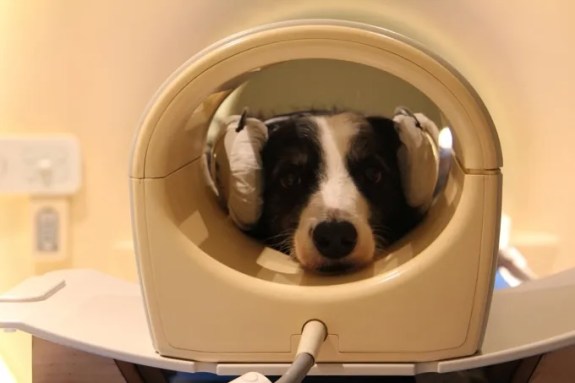
To find out, Cuaya and her team started by training 14 family dogs to stay still inside an MRI scanner. “They are very, very good at the task,” Cuaya says. The machine would then track the dogs’ brain activity.
Who’s a good boy?
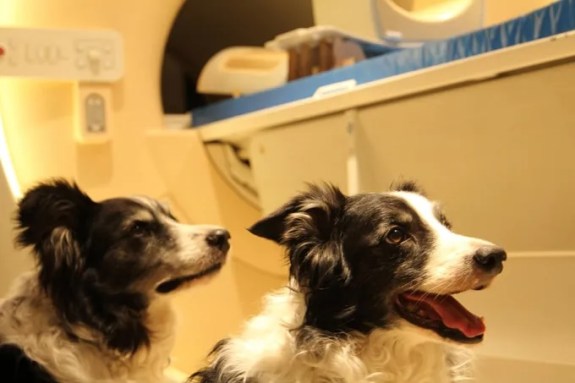
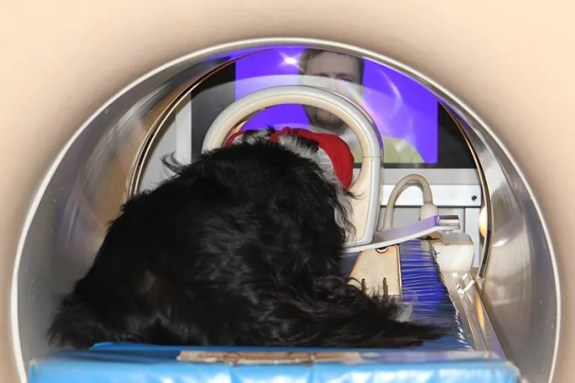
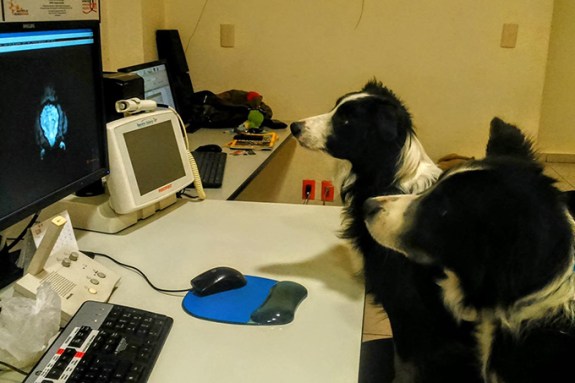
Odin and Kun-Kun (right) are two participants in a study that examined activity in dog brains. Researchers trained the pups to sit still inside an MRI machine while looking at pictures of human faces. The dogs’ brains lit up in different patterns depending on what emotions the faces showed. Scroll through to see just how good a boy Kun-Kun is.
 LAURA V. CUAYA
 LAURA V. CUAYA
 LAURA V. CUAYA
 LAURA V. CUAYA
In one experiment, dogs looked at images of unfamiliar faces with happy or neutral expressions. Happy faces lit up a reward region in the animals’ brain more than neutral faces did. In another experiment, the researchers tested several negative emotions. The dogs’ brains reacted differently to angry or sad faces versus fearful ones.
The researchers shared these findings August 10 in iScience.
This is the first evidence that dogs can distinguish between negative emotions on our faces, Cuaya says. It suggests dogs can process emotional information in more detail than scientists once thought.
But the findings might not be the same in all dogs, Cuaya cautions. Her group focused on border collies and golden retrievers.
Her team is now working on another MRI study in dogs. This one looks at how the canine brain responds to a certain sound that dogs make. It’s thought to be their version of laughter.
What about cats? Cuaya’s team is not planning any MRI studies in them. Our feline friends may be a bit harder to coax into sitting still for brain scans.
Do you have a science question? We can help!
Submit your question here, and we might answer it an upcoming issue of Science News Explores





 Bengali (Bangladesh) ·
  English (United States) ·