

Is it a good idea to use artificial intelligence (AI) for math help? Yes — and no. That’s based on the results of a new survey. AI can be a great tutor, it finds, but only if you use it in certain ways.
The data come from a poll of 1,300 high school students from across the United States, England and Wales. The Society for Industrial and Applied Mathematics surveyed some top math students in each nation. The goal was to identify the habits behind their academic success.
AI has many strengths as a math tutor, the study found. Students can use AI to explain things in different ways and to check their homework answers. It can answer “why” questions about material to deepen their understanding. AI can tailor learning by identifying a student’s knowledge gaps. Using AI as a tutor could even reduce math anxiety, some students said.
Scientists Say: Artificial intelligence
But there are potential downsides to AI tutoring as well, notes Robbie Torney. AI was designed to reduce friction — meaning it aims to do things quickly and efficiently. But learning “requires friction,” says Torney, who was not involved in the survey. He heads up AI & Digital Assessments at Common Sense Media. It’s a nonprofit group working to make the digital world safer for children and teens.
Science shows that learning requires grappling with problems, Torney notes. You have to work through things that feel hard and come up with your own answers.
Tiago C.P. agrees. To this Colorado high-school senior (who did not take part in the survey), the most important thing is “trying the problem first.” This is where students struggle, he adds, but “that’s when you get the learning down.” Says Tiago, “I won’t use AI before I’ve fully attempted a problem.”
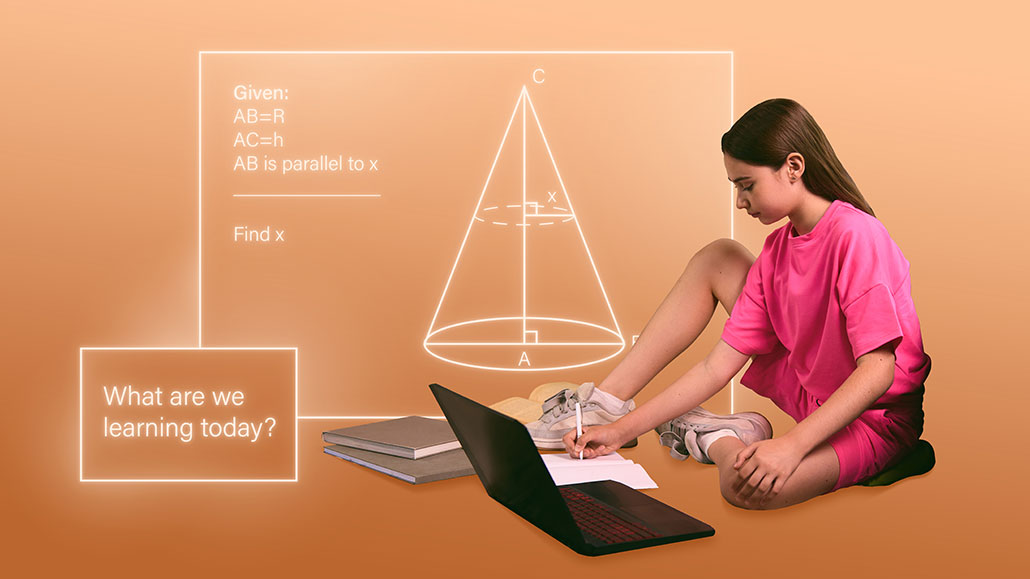 Using AI for help with homework or when studying for tests can be fine — as long as you keep thinking, doing the work and using a range of other resources, too.Anton Vierietin/iStock/Getty Images Plus
Survey says
The teens in the study had all taken part in an international math contest. Afterward, they gave their take on whether AI could be an effective math tutor. About half said yes — if the AI was used in specific ways. More than 200 math teachers also took part. More than six in every 10 agreed that an AI tutor could be beneficial. But AI could also decrease learning if used improperly, they noted.
Almost two thirds of students surveyed (63 percent) said they would always try a math problem on their own before seeking help from AI. If they were struggling, where would the students turn? Most recommended first asking teachers (58 percent), followed by classmates (50 percent). Others said they’d continue to try on their own (48 percent) or look for tutorials on the internet (46 percent). At 39 percent, AI came in fifth place.
That suggests using AI after trying most other sources of help. The number one suggestion for how to do well in math was doing regular practice problems. That’s according to both students (67 percent) and teachers (62 percent).
Overall, about half of the students said they believe AI has a place in math education. But they added that it is best used along with — not in place of — help from their classroom teacher. For one thing, “It’s hard to get AI to teach you the same way your teacher would,” says Amelie M., another Colorado senior (who did not participate in the survey).
 Ask questions of your human teachers, not just of your AI tutor. A range of teaching styles can boost understanding. Also, people can understand each other better than AI can. Klaus Vedfelt/DigitalVision/Getty Images Plus
How to use AI for homework wisely
More than half of the teachers in the study (55 percent) said AI’s biggest benefit is its ability to explain — step by step — how to solve a problem.
But relying on it can harm learning in the long run. Almost three in every four teachers surveyed said their biggest concern was that AI can quickly become a crutch.
Amanda Brown teaches math at Broomfield High School in Colorado. When learning something new, you can use AI for help, she says. But as you become more familiar with the subject, studies show, you should turn to AI less and less.
Torney recommends asking yourself (or even the AI): “Who’s doing most of the work?” Whenever it’s AI, he says, that likely points to a problem.
“I see kids that have perfect homework scores,” Brown says, who later “don’t pass their test.” AI might have helped them ace the homework. But in the end, Brown notes, “You’re gonna have to take the test [without AI].” And that’s when it comes out: Do you know the material or not?
5 things to remember when talking to a chatbot
The trick is using AI in moderation, agrees Amelie. Try to ask it very specific questions, she says, such as: “What are different ways I could solve this?” Amelie also suggests adding to your prompt: “Don’t give me the answer.”
Tiago warns that you also need to check whether AI is correct. Although chatbots keep improving, they sometimes “hallucinate” (make errors). This is because AI doesn’t actually know the answer. It just predicts what is the most likely answer from the data it has ingested. “At least a quarter of the time,” Tiago says, “I can catch a mistake it’s made.”
Remember that you can also work on problems with classmates. And teachers are likely your best source for homework help. “Learning has always been a social task,” Torney points out — “something that we do with other people.”
 Studying in groups can turn learning into a “social task.” Those who understand something better can coach peers. People have different ways of learning and can benefit from others’ approaches. Jacob Wackerhausen/iStock/Getty Images Plus
Beyond homework
AI can be a good helper as you prepare for tests, Tiago finds. It can generate sample problems, create flash cards or drill you on concepts. Or if you were out sick for a few days, AI might help you catch up on topics you missed.
But AI will “pull from so many things,” says Amelie, that it can return “long, long paragraphs” of info. This “might actually be more overwhelming” than helpful, she points out. What might prove more beneficial are YouTube instructional videos that AI references, she says. Such videos show someone actually teaching you.
A math hack: You can also ask AI to tell you about your own thinking and learning. The surveyed teachers suggested letting AI test you to find gaps in your knowledge. Students recommended asking AI “why” questions about math. These could make you a better learner.
Do you have a science question? We can help!
Submit your question here, and we might answer it an upcoming issue of Science News Explores
The long game
Math is a bit like learning a sport. You have to learn certain skills and in a certain order. Consider ice hockey. Until you learn how to skate — and how to stop — you’ll have a tough time mastering a slap shot.
In math, if you don’t learn factoring, you’ll have trouble in algebra. If you don’t learn algebra well, calculus will be a bear. This is why Torney advises that you “keep your eye on the long game.”
And learning takes work. “When it’s easy,” Torney says, “learning is probably not happening.” If you’re using AI for help with math and don’t feel like you’re working very hard, change how or where you get help.
Torney offers a last tip: Choose your AI platform wisely. Chatbots such as ChatGPT, Gemini, Claude and Copilot are “multi-use” systems. They can tackle any topic — not just math. Platforms such as Mathos and Wolfram|Alpha answer questions just on math. And the discontinued (but still available) Khanmigo focuses on education.
Some students who use multi-use systems for math can start relying on them for social advice or emotional support, too. This can lead to dependency in some people. That’s why systems focused on a single topic, Torney says, “tend to be less risky for kids and teens.”
Using AI to help you understand math better can be a great thing. Just keep in mind this mantra from the teacher survey: “It’s critical for students to arrive at the correct answers themselves.” Use AI to learn concepts, not get answers.





 Bengali (Bangladesh) ·
  English (United States) ·