

After the asteroid impact that wiped out the dinosaurs, life seems to have bounced back with surprising speed. The first wave of marine species emerged within a few thousand years of the mass extinction, a new study finds. That’s many millennia faster than many scientists thought.
“This really helps us understand how quickly species can evolve,” says Christopher Lowery. He works at the University of Texas at Austin. There, he studies the physical and biological features of ancient oceans.
The Chicxulub (CHEEK-shuh-loob) asteroid struck Earth 66 million years ago. Studying its aftermath provides a rare chance to learn how past ecosystems rebounded from disaster, Lowery says.
And the new findings mean scientists need to rethink how fast evolution can rebuild a diversity of life. That may be important as climate change and other human actions speed Earth toward ecosystem upheavals.
Settling timelines
The new clues come from fossils of organisms known as foraminifera (For-am-ih-NIF-er-uh), or forams. These single-celled ocean dwellers build mineral shells. As a type of plankton, forams float through the ocean. One of the first such organisms was P. eugubina (YOO-gu-bee-nuh).
Its appearance serves as an early indicator of life’s recovery after the asteroid.
A 2011 estimate placed its first appearance about 30,000 years after the Chicxulub impact. Scientists measured the thickness of rock layers between that of the extinction and signs of P. eugubina in the fossil record. Then they estimated the time that had passed using rates at which materials settle out of water.
But those rates were averages calculated over a very long time period. They might not capture what happened right after the asteroid hit.
Lowery himself never questioned the timeline. That is, until it began to clash with other evidence he saw.
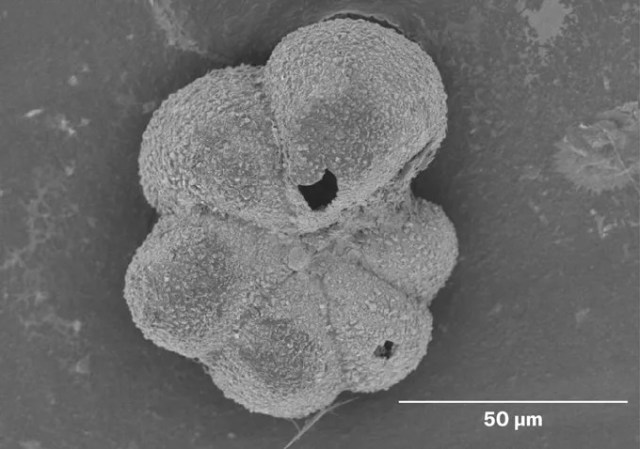 A floating ocean dweller P. eugubina is shown in this microscope image. This species’ appearance in sediments from ancient oceans marks life’s recovery after the Chicxulub impact.C. Lowery
He was part of a team that analyzed sediment cores drilled from the Chicxulub crater. They measured levels of helium-3. That’s a rare form of helium, the balloon-filling gas. Cosmic dust carries this form of helium to Earth at a nearly constant rate. The new measurements allowed the team to calculate how quickly sediments piled up right after the impact.
P. eugubina evolved within just 6,000 years of the dino-killing event, those cosmic dust data indicated. But Lowery hesitated to trust that result.
His team looked for published data from elsewhere in the world. They focused on sites where researchers had measured helium-3 and identified the first post-extinction forams.
They averaged data from six sites. These included the Chicxulub crater and marine deposits in Italy, Spain and Tunisia. Together, these suggested that the sediments built up over far less time than previously thought.
Lowery’s group shared its findings January 21 in Geology.
Breakneck evolution
On average, P. eugubina appeared 6,400 years after the impact. Other new plankton showed up within just a millennium or two. All these new species burst onto the scene, filling empty spots in ecosystems. Those holes had been created when the Chicxulub asteroid killed off three-quarters of all plant and animal life.
The new, shorter timeline matters. The Paleocene epoch stretched from 66 million to 56 million years ago. Scientists have long thought of it as a long, slow crawl back from catastrophe. But it now appears it may have been a period of extraordinarily rapid evolution. Lowery’s timeline may even understate how quickly species began to recover.
Brian Huber is a paleobiologist. He works at the Smithsonian’s National Museum of Natural History in Washington, D.C. Last year, he was part of a team that shared results from temperature signals locked inside foram shells. The new plankton species, they found, likely emerged within mere decades of the asteroid impact.
His team then paired the fossil record with computer models of climate. The skies quickly cleared after soot and dust from the impact choked the atmosphere, they found. Rapid global warming followed. In the recovering oceans, this warmth may have jump-started a burst of evolution.
Do you have a science question? We can help!
Submit your question here, and we might answer it an upcoming issue of Science News Explores
Huber’s results draw on data that differ from Lowery’s. If Huber’s timeline holds up, it would suggest new species arose far quicker than once thought possible. “It’s a real eye-opener,” Huber says.
Together, the findings highlight how quickly biology can innovate after calamity. “Life really starts to rebound as soon as there is any possibility,” says Vivi Vajda. She is a paleobiologist at the Swedish Museum of Natural History in Stockholm. She did not take part in the research.
Breakneck evolution of new species cannot, however, swiftly fix a mass extinction, Lowery says. It still took millions of years for ecosystems to fully recover, he points out. And nothing like the ancient dinosaurs ever returned.
Evolution, it seems, is capable of sudden brilliance, but not of instant repair.




 Bengali (Bangladesh) ·
  English (United States) ·