
 7 hours ago
6
7 hours ago
6 
When I was a proto-embryonic critic, in my painfully awkward junior high school years, my reading was wildly incongruous. Isaac Asimov’s Science Fiction Magazine to Siddhartha to The Grapes of Wrath to cheap, used Harlequin Regency romances.
I had weird middle of the night reveries about what I might grow up to be. Becoming a nun seemed attractive, perhaps a challenge as I wasn’t Catholic. Maybe a kind of whirling dervish/Siddhartha-type nun, instead?
I wanted a purpose: a reason why I was here. I wanted to be worthy of something. Sacrifice the self for a greater cause. Or perhaps, I wanted to fit in a world that didn’t seem to have room for my oddling ways.
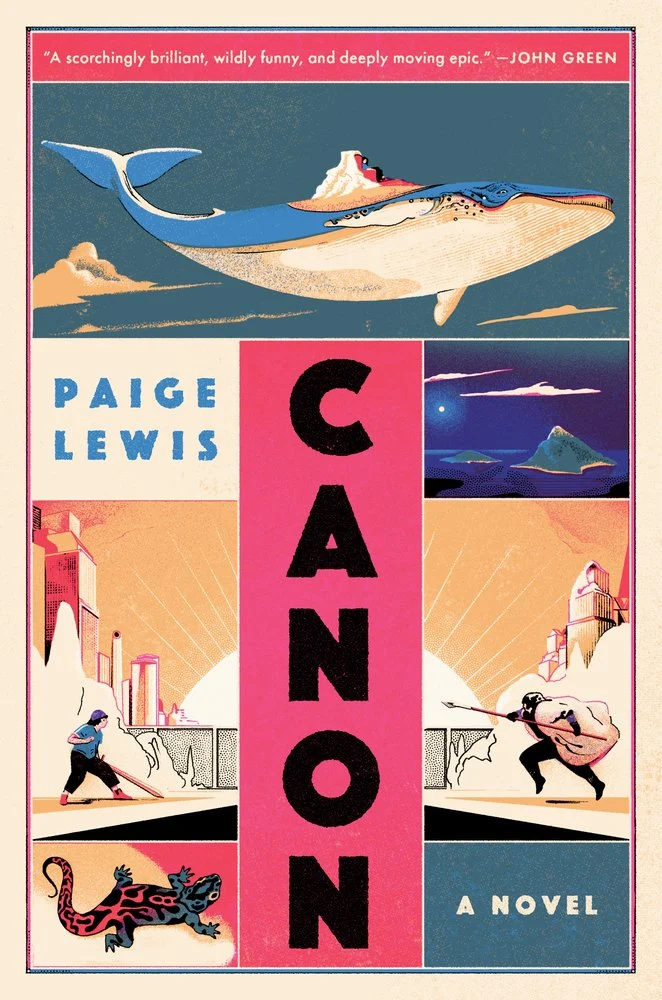
Paige Lewis’s exhilarating debut novel Canon is a modern epic about individual agency within the context of grim, nearly apocalyptic times; the lies and violence that “higher powers” exert upon us; and the truths we can only determine for ourselves. And along the way, it’s also a rollicking good tale, with Lewis’s intelligence, wonder, heart, and charming humor on full display. The momentum of the book is built through swift, sharply drawn chapters—with titles such as “Small Blips of Joy Keep Weary Prophets Going”—along with a kaleidoscopic narrative and Lewis’s joyful polyvocality. Ultimately, amid the madness—perhaps because of it—it’s especially about the enduring power and beauty of love.
I realize now that perhaps what I wanted most when I was an awkward child was to transform, to evolve into something, anything, greater. Amid all the chaos within the multitudinous realms and characters of Canon, the core of Lewis’s uncategorizable novel is about this “becoming”—creation through destruction, which is both our fate and our reward. In Lewis’s world, we are our own divine intervention.
Mandana Chaffa: The word canon has a complex etymology, initially referring to decrees of the church, and in modern times also as a reflection of an academically approved—traditional—literary “standard” of excellence. This Canon offers a definitive upending of such doctrines, and a rigorous interrogation of prevailing sanctioning bodies. What were you contemplating when you titled the book, and when did you end up with the title?
Paige Lewis: Mandana! I’m so grateful for the time you’ve given to my book and for this fantastic question. I wish I could just copy and paste what you’ve said about my title upending religious and literary doctrines. But the truth isn’t very thrilling—the title came very late in the writing process. I hate coming up with titles and would have never landed on Canon on my own. As I was getting closer to finishing the manuscript, I brought up my titling frustration with Kaveh [Akbar, Lewis’ spouse]. So, we made a long list of title ideas pulled from different sections of the manuscript, and I chose Canon from that list.
Trying to choose from a long list reminded me of when the poet Marianne Moore was asked by Ford Motors to come up with a name for a new car model. She came up with so many incredible names (Utopian Turtletop, Mongoose Civique, Thunderblender, The Intelligent Whale). All were rejected.
Binaries like good and evil often flatten our understanding of the world, and this flattening makes humans easier to deceive.
Part of me wanted to use The Intelligent Whale for my book title, but I think Canon is more fitting. And I do love a one worded title.
MC: Canon also questions binaries in favor of rich multiplicities. One of the most damaging of the former might be societal edicts of good and evil that reduce the complexities of humanity to two-dimensional moralities. They are nearly worthless in offering a blueprint to remaining humane in a darkening world, and this book is deeply invested in an individual’s agency, in the decisions one can make, in the responsibilities we have to ourselves and each other.
PL: I’m sure philosophers have said it far better than this, but to me, the good vs. evil dichotomy is bullshit. It’s something that those in power use to control the narrative while committing appalling acts. A pervasive example: Israel uses this binary to shape the narrative of their ongoing genocide against Palestinians as a fight against evil. Amichai Eliyahu said, “Thank God, we are wiping out this evil.” Benjamin Netanyahu said Israel is “[G]oing to abolish this evil in order to further all humanity.”
And yet we have seen Israel murder over 50,000 children in Palestine since October 2023.
We have seen Israel “manufacture a consent to kill” by claiming that journalists murdered by the IDF had ties to Hamas.
Binaries like good/evil often flatten our understanding of the world. And this flattening makes humans easier to deceive. Does anyone ever think they might be on the side of evil?
Mandana, I know you didn’t ask a question here, I’m just angry all the time and this seemed like as good a place as any to remind people that they should be angry, too.
MC: There’s a strong element of ecoprose throughout Canon which speaks to our current environmental disasters as well as to a host of ancient mythologies in which nature is a kind of deity. I appreciate that you don’t shy away from the complexities of nature—its beauty, power, and sustenance, and also its brutality (though not purposefully cruel).
PL: When I was young, I could watch any nature documentary. Now, it’s hard for me to watch anything if I suspect nature is about to be itself. I find myself both rooting for the lion and the gazelle and am sad no matter the outcome. So, it means a lot to hear that you think I did right by nature in this book.
MC: Might we talk about structure and form? Canon is both lyric and epic, and many chapters of the book—some quite spare in prose, others fuller—resemble the motion and space of poetry collections. Which makes me also want to talk about genre with you: So much of the contemporary literary landscape smudges such boundaries. Did you always anticipate the structure you ended up with? How many iterations of form did you have in mind?
I wrote the story the same way I write poetry, without knowledge of where it would go.
PL: I started this book as a one-page poem about a character from the Bible. I was inspired by Anne Carson’s “Book of Isaiah, Part I” and thought it would be fun to try it with the character Yael from the Book of Judges. Once I “finished” the poem, I showed it to Kaveh (who is always my first reader), and he said it was good but not finished. So I moved from that to writing an epic poem (the first few sections of which appeared in Poetry magazine in 2018). After I showed a “finished” copy of the epic to my agent, Jacqueline Ko, she helped me realize that I was writing a novel. So, then I spent a few years expanding the sections into chapters and adding new characters and adventures. But the poems never really left the book. They are more noticeable in some sections because of the use of empty space and lineation, but some of the most textually dense sections are also poems (especially the sections that include dreams).
Genre has always been a frustration, and I’ve decided the best thing, for me, is to step away from trying to categorize Canon as anything beyond it being a thing I made.
MC: In the past, we’ve talked a bit about speculative fiction—might you touch on your pedagogy around that genre, as well as how it plays into this particular work? What are your favorite examples of worldbuilding, and how did they impact what you wanted to create in Canon? How did this world shift as you moved through different drafts of the novel?
PL: I love to read and teach science fiction and was heavily influenced by the world building in books by writers like Ursula K. Le Guin, Octavia Butler, and Pamela Zoline. I was also really drawn to S.F. that didn’t take itself too seriously and allowed for humor and absurdity. I’m thinking particularly of Frederik Pohl’s “Day Million” (published in 1970), which is one of my favorite short stories to teach. It’s usually pretty pohl-arizing—half the class loves the humor, and half thinks it’s too much.
In the story, Pohl’s narrator tells the reader about a love story between a boy and a girl in a future society in which gender is fluid and relationship norms (and most societal norms really) have drastically changed. The woman in the story, Dora, is born with XY chromosomes, but genetically altered in the womb because: “If we find a child with an aptitude for music we give him a scholarship to Juilliard. If they found a child whose aptitudes were for being a woman, they made him one.”
So, I’m sure it would have been easy for Pohl, especially in the ‘70s, to get his laughs by mocking this future society’s gender norms, but instead he often breaks the fourth wall to make fun of the reader’s own conservative views: “Go ahead, and grumble. Dora doesn’t care. If she thinks of you at all, her 30 times-great-great-grandfather, she thinks you’re a pretty primordial sort of brute. You are.”
So, perhaps more than worldbuilding, S.F. has really influenced my understanding of a narrator’s relationship with the reader.
MC: Related to this last question: What were your initial expectations for Yara and multiple narratives adjacent to them, and how did that shift as their story evolved? What came first: your narrative intentions or the characters?
So many epic heroes are lonely on their journey.
PL: It started with Yara on their journey. And then I felt there needed to be a second journey, so Adrena was born! And then Adrena needed something to convince Harpo to let her join him and his army, so Arielle and her kidnapping came into being. I feel like many characters and actions came into existence as the narrative started to take shape. I wrote the story the same way I write poetry, without knowledge of where it would go. But Yara was always there.
MC: There’s also an expansive exploration of the shades of loneliness, isolation, and alienation in Canon, that feels particularly resonant right now, especially in our hyperconnected world, which distances more than it engages. Not to mention that these mindsets increase the risk of being taken in by sects, discipleships, cults, and the like. Even popular culture fandoms feel like closed loops. Though Yara’s story upends that narrative, as they ultimately free themselves. I appreciated that arc—they didn’t completely understand what they were drawn into, and what the cost of it was, but still had the agency to determine the next part of their life.
Delving into that a bit further: There’s the larger monomyth, the subject of many an epic: the overall idea of the Hero’s Quest whereby the protagonist sets off on a fraught, challenging mission and journey of self-discovery, only to discover the answer was in choosing personal identity over the demands of larger, often flawed societal machines. What are the epics that have spoken to you as a reader and writer?
8 Pre-Apocalyptic Novels
Step aside, post-apocalypse. These books ring the alarm bells for an apocalypse yet to come

PL: Sometimes I can only speak for myself. I grew up in a house with a lot of people in it, but because of my OCD and how it manifested, I was always given my own room. No one in my family was allowed in my room, and if I left my room, I would have to shower before I could touch anything in my room again. So, I spent a lot of time alone in my room because it saved me time and energy (and it saved water). Understandably, my behaviors affected the rest of my family. So, when I would come out to interact, my siblings would, from a place of hurt, make comments about how I wasn’t really a part of the family. And so, I would go back to hiding in my room. I didn’t feel lonely, but I was in some ways in a perpetual state of alienation. I’m also sure this has something to do with why I’m so drawn to epic poetry. So many epic heroes are lonely on their journey. Even when surrounded by soldiers, or sidekicks, or friends, the hero sort of functions at a remove from others. The hero has a mission, and they also have hope that the mission will eventually end, that they will be able to go back home to their family and/or their everyday lives. Some epics that influenced my own exploration of isolation, loneliness, and/or familial estrangement are: The Tale of Kiều by Nguyễn Du, Does Your House Have Lions? by Sonia Sanchez, Aniara by Harry Martinson, The Odyssey by Homer (translated by Emily Wilson), “The Anniad” by Gwendolyn Brooks, The Descent of Alette by Alice Notley
MC: You used to wake up very early and get in a couple of hours of poetry writing before teaching your students, which both wowed and intimidated me. Do I remember this right, and do you still do that? How has your writing and process changed over the years, especially given your full professional and personal life? What’s the smallest unit of a writing life that people might be able to perform on a daily basis, that accumulates into a practice?
PL: Yes! Even when I taught eight a.m. classes, I would wake up a few hours early to get some writing in. I have found this to be a bit more difficult now that I have four needy animals who make writing at home nearly impossible, and because most coffee shops open at seven a.m. (at the earliest) in Iowa City. I don’t think people need to write daily, though I do think it has been very good for my routine-driven brain. What can feel less daunting is for a writer to carry a small notebook around with them (or to treat their notes app like a notebook) and jot down a few things every day while running errands or meeting friends. This is a great way to get descriptions of different locations or weird quotes from a stranger who’s talking too loud at a restaurant. Then, when you have time to sit down to write a poem or a scene, you have so much material saved up to pull from!
The post A Debut Novel About Individual Agency in Apocalyptic Times appeared first on Electric Literature.




 Bengali (Bangladesh) ·
  English (United States) ·