

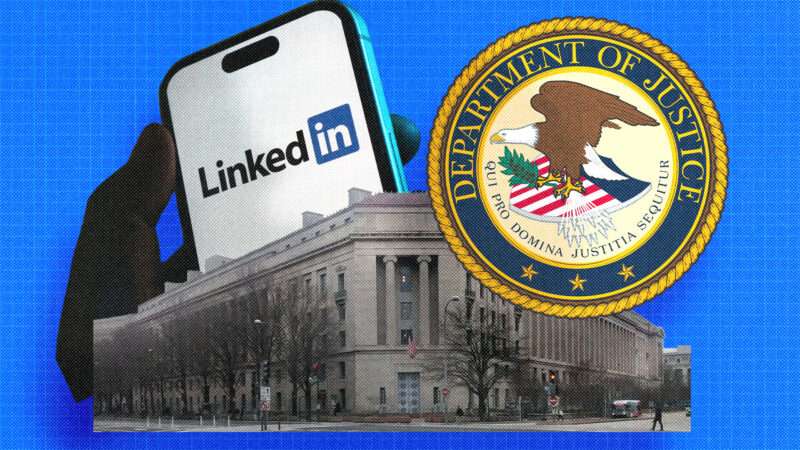
"Confidentiality of sources is the lifeblood of a free press," Judge J. Harvie Wilkinson of the U.S. Court of Appeals for the 4th Circuit wrote in a unanimous opinion released Tuesday.
In a case that remains shrouded in secrecy, Wilkinson ruled that orders from President Donald Trump's Justice Department (DOJ) were "substantially overbroad" when the government asked LinkedIn to disclose information about journalists it was targeting as part of an undisclosed national security leaks investigation.
Wilkinson found that the DOJ's Disclosure and Secrecy Orders—which a district court approved under the Stored Communications Act (SCA)—infringed on the First Amendment rights of LinkedIn and its users. The SCA prohibits digital service providers such as LinkedIn from sharing users' electronic communications with any person or government entity without a search warrant, court order, or subpoena.
The Justice Department has been conducting a yearslong investigation into a national security leak stemming from an unnamed article published at an unnamed news outlet. The government alleges that the news outlet published an article "purporting to describe a top-secret United States military operation in a foreign country" that revealed "classified information never previously reported." As part of its investigation into the leak, the Justice Department sought a "Disclosure Order" that obligated LinkedIn to "produce the records of many journalists." The Disclosure Order directed LinkedIn to "assemble and divulge the targeted journalists' metadata records" over an 18-month period in which one journalist wrote over 1,000 articles unrelated to the investigation.
As part of its probe, Politico reported that the Justice Department was "demanding details of about 1,900 LinkedIn interactions from six users." The Justice Department's order directed LinkedIn to include the metadata records of every user the targeted journalists interacted with for any story published within the 18 months. As Wilkinson noted, had LinkedIn complied with the order, the government would have acquired data on a large number of users (including confidential sources) with "no conceivable relationship to the leak investigation." The Justice Department also "sought and obtained" a Secrecy Order that prohibited LinkedIn from "divulging the existence of the Disclosure Order to the targeted journalists, the News Outlet, or anyone else for one year."
In November 2025, LinkedIn challenged the orders as "overbroad under both the SCA and the First Amendment." The company asked the court to narrow the Secrecy Order "such that it could inform a single, previously government-vetted lawyer for the News Outlet of the Disclosure Order." LinkedIn would then work with the government-approved lawyer to "identify ways to narrow the Disclosure Order." However, the Trump administration argued that LinkedIn had no standing to bring a claim and that the platform could not "assert the First Amendment interests" of the investigation's targets.
The 4th Circuit disagreed, finding that LinkedIn had "suffered three kinds of sufficient injury in fact." Wilkinson wrote that it should have been "obvious" that the Secrecy Order prevented the targeted journalists and news outlets from asserting their First Amendment interests because it "keeps them entirely in the dark." Without LinkedIn intervening on their behalf, Wilkinson wrote, the "risk to their First Amendment rights is significant."
In its ruling, the 4th Circuit noted that service providers such as LinkedIn have routinely been allowed to advocate for third parties' rights when they seek "'access to their market or function.'"
The court reasoned that LinkedIn's relationship with its users would be "damaged" if journalists stopped using the platform to communicate with confidential sources because of the Disclosure Order. The 4th Circuit rejected the government's argument that LinkedIn couldn't possibly have a "sufficiently close" relationship with its users to argue on their behalf, because it has over 1 billion members.
While Wilkinson found the national security interests in the case "self-evident," he wrote that the government's entitlement to a broad disclosure order did not mean it had "carte blanche" to obtain records irrelevant to the investigation. The case will now go back to the district court, which must consider the government's need for the Disclosure Order, whether every record sought is relevant or if the request can be narrowed, and "any First Amendment and SCA standards implicated by the Disclosure Order." The Justice Department will have to explain why LinkedIn's narrow disclosure would compromise its investigation. However, if the government fails to make a convincing argument, the court will have to adopt LinkedIn's proposal to narrow the Secrecy Order.
Ordering service providers such as Meta, Google, X, and LinkedIn to provide the government with user information has lamentably become commonplace. Past and present presidential administrations have been all too eager to downplay the First Amendment when they run afoul of its protections. In January 2023, Jack Smith, as special counsel, obtained a search warrant for data and records from Trump's Twitter (now X) account. Smith then obtained a nondisclosure order barring X from notifying Trump about the warrant. In October 2024, the Supreme Court declined to hear an appeal from X, leaving the nondisclosure order in effect.
During the second Trump administration, the Justice Department has raided reporters' homes and seized their electronic devices when investigating leaks. The administration has subpoenaed independent journalists for reporting on military actions in North Korea. The administration has also subpoenaed reporters at The Wall Street Journal and The Washington Post for reporting on the Iran war. In July, Attorney General Todd Blanche authorized grand jury subpoenas to several New York Times reporters and their communications providers over stories about the Qatari-donated Air Force One.
Blanche has disputed accusations that his department is targeting reporters. Instead, he's likened the Justice Department's treatment of reporters to that of a "material witness to a car crash." But the First Amendment protects the free press and its ability to report on subjects the government would otherwise prefer to keep hidden.
As Wilkinson wrote, "Without confidentiality, the ability of journalists to report on events of large importance and governmental behavior of dubious legality and integrity could not help but be hampered."
The post 4th Circuit Rebukes Trump Administration for Asking LinkedIn To Turn Over Info on Critics in the News Media appeared first on Reason Magazine.



 Bengali (Bangladesh) ·
 English (United States) ·