

Lawyers who aren't members of a court's bar can still usually represent clients in that court, so long as they ask for admission "pro hac vice" (for this occasion only) and engage a local counsel who is a member of the bar. Unsurprisingly, this means local counsel will be responsible for the pro hac counsel, as an opinion from Magistrate Judge Mark Clarke (D. Ore.) yesterday in Couvrette v. Wisnovsky illustrates:
The Court ORDERS [local counsel] Mr. Murphy to pay [$14,205.66, which is] 15% of Defendants' Amended Bill of Costs and Reasonable Attorney Fees. Mr. Murphy is also ORDERED to attach this Opinion and Order with any future motions for leave to appear pro hac vice in which he seeks to associate as local counsel in the District of Oregon….
Ms. Couvrette … [had] asked Mr. Murphy to serve as local counsel for Mr. Brigandi's pro hac vice admission. Mr. Murphy signed Mr. Birgandi's pro hac vice application and personally attested that he read and understood the requirements of serving as local counsel under LR 83-3….
Mr. Brigandi's son was dating Ms. Couvrette's daughter, and Mr. Brigandi had agreed to represent Plaintiffs for free. According to Mr. Murphy, Mr. Brigandi was primarily responsible for the litigation strategy and for all dispositive motions practice. Mr. Murphy explained, "[m]y role mostly involved strategizing with Mr. Brigandi and Ms. Couvrette on how to fashion a settlement in connection to the commercial property…. I believed that my expertise in landlord tenant law would be helpful." …
At issue before the Court is whether Mr. Murphy willfully violated [Local Rule] 83-3 by failing to meaningfully participate in the case. Mr. Murphy argues that the Court should not impose a sanction because he did not participate in the summary judgment briefing and he was unaware that the Local Rules required him to review his associated pro hac vice counsel's filings prior to submission.
Local Rule 83-3 provides in relevant part:
(a) Application for Special Admission Pro Hac Vice
Any attorney who is an active member in good standing of the bar of any United States court, or the highest court of any state, territory, or insular possession of the United States, may apply to be specially admitted pro hac vice in a particular case, provided he or she:
(1) Associates with an attorney admitted to general practice before the bar of this Court, who will meaningfully participate in the preparation and trial of the case.
To appear pro hac vice, the out of state attorney must file a motion for leave to appear pro hac vice. Within that motion, the associated local counsel often (as here) certifies that they read and understand the requirements of LR 83-3 and that they will serve as designated counsel in the case…. Here, Mr. Murphy does not dispute that he failed to meaningfully participate in the case….
Mr. Murphy argues that his failure to meaningfully participate in the case was not done willfully or in bad faith. From Mr. Murphy's perspective, the term "meaningfully participate" is vague. He argues:
[n]either this court's local rules, nor the court's prior admonition from its December 16, 2024 order, direct that Respondent was expected to serve as a check on, or guarantor of, Mr. Brigandi's legal work. And even if such requirement was expected by this court (without an express directive to that effect), there is no evidence to suggest or find that Respondent knew that was his responsibility, willfully failed to undertake that responsibility, or did so for an improper purpose. At most, any failure on the part of Respondent in this regard was unintentional, inadvertent, and an error in judgment.
The Court disagrees.
Mr. Murphy's purported lack of notice about the requirements of LR 83-3 is not well taken where, as here, the Court specifically warned the parties [after an earlier error by Mr. Brigandi] that "[n]oncompliance with Local Rules is not something this Court takes lightly[,]" and it advised that Mr. Murphy should "help ensure compliance with Local Rules." Despite the Court's express guidance, Mr. Murphy took no steps to mitigate Mr. Brigandi's continued noncompliance with the Local Rules. {For example, Plaintiffs' Motion for Summary Judgment (ECF No. 142): (1) contained a false certification that it contained fewer than 11,000 words, violating LR 7-2(b); (2) failed to comply with the formatting and filing requirements of attaching exhibits and declarations, violating LR 10-1(e)(2) and LR 10-3(a); and (3) failed to comply with factual citation requirements on summary judgment, violating LR 56-1. These violations were in addition to Mr. Brigandi's violations of LR 83-7 for the use of non-existent cases and fabricated quotations.} Having been put on notice of Mr. Brigandi's propensity to violate the Local Rules, Mr. Murphy's failure to review any of Mr. Brigandi's work prior to submission was a willful violation of LR 83-3.
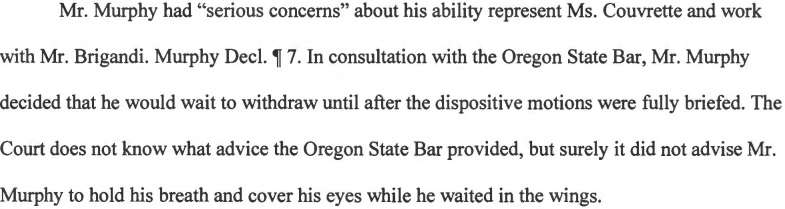
[In light of circumstances that emerged during the case,] Mr. Murphy had "serious concerns" about his ability represent Ms. Couvrette and work with Mr. Brigandi. In consultation with the Oregon State Bar [which Mr. Murphy asked about the timing of a possible withdrawal -EV], Mr. Murphy decided that he would wait to withdraw until after the dispositive motions were fully briefed.
The Court does not know what advice the Oregon State Bar provided, but surely it did not advise Mr. Murphy to hold his breath and cover his eyes while he waited in the wings. Having discovered that Ms. Couvrette and Mr. Brigandi were practicing duplicative litigation without his knowledge or input, Mr. Murphy was subjectively aware of their untrustworthiness. Under these circumstances, Mr. Murphy's decision to exercise no oversight exceeds a merely negligent violation of LR 83-3.
Mr. [Murphy] agreed to act as Oregon counsel, presumably was compensated for that role, and he should not be heard now to profess no responsibility for the acts of the lawyer for whom he vouched and for whom he served as a conduit in this district. Mr. Murphy signed Mr. [Brigandi's] pro hac vice application and personally attested that he read and understood the requirements of serving as local counsel under LR 83-3.
While meaningful participation does not ordinarily require local counsel to confirm the veracity of their associated pro hac vice counsel's legal citations, it necessarily requires local counsel to provide more than an [Oregon State Bar] number and a signature on the pro hac vice application. We will never know what could have been prevented had Mr. Murphy meaningfully participated in this case. What we know is that Mr. Murphy chose not to participate in this case, meaningfully or otherwise. Mr. Murphy's decision not to participate in this case—despite the Court's stated expectations on the role of local counsel and his own "serious concerns" about Ms. Couvrette and Mr. Brigandi—evidences a willful violation of LR 83-3. The Court's authority to sanction an attorney for a violation of the Local Rules is appropriately exercised under the circumstances of this case….
The Court previously awarded Defendants reasonable attorney fees and costs directly resulting from Plaintiffs' submission of the summary judgment briefing. The Court has closely … finds the requested amount of $94,704.38 reasonable. Mr. Murphy is ORDERED to pay Defendants 15% of that award, $14,205.66 within thirty (30) days of this Opinion and Order…. Mr. Brigandi is ORDERED to pay Defendants the remaining 85% ….
Mr. Murphy attests that he will never appear again in this district as local counsel in association with pro hac vice counsel. The Court does not impose such a ban on Mr. Murphy but ORDERS him to ensure that a copy of this Opinion and Order is attached to any future pro hac vice motion sponsored by Mr. Murphy as local counsel in this district….
The post $14K Sanction for Local Counsel's Not Meaningfully Supervising Out-of-Jurisdiction Counsel appeared first on Reason.com.





 Bengali (Bangladesh) ·
  English (United States) ·